
Carlisle Castle


Carlisle is the great fortress city at the west end of the Scottish Border. Roman Luguvallium grew up in the shadow of Hadrian’s Wall and some vestige of the town remained when William II captured it in 1092. William repopulated Carlisle with Anglo-Norman settlers and founded the great royal castle on a bluff above the River Eden.

Carlisle Castle is an impressive reminder of centuries of strife. It sits grim and squat at the north end of the old walled city, still a medieval stronghold but much patched up after the many batterings it has endured. The layout is roughly triangular, comprising two walled baileys but no motte. The curtain walls are basically Norman. Two flanking towers survive on the west side but the walls are otherwise quite plain. During the Civil War the Scot’s tore down the cathedral nave to repair the damage wrought during the siege.

The outer gatehouse facing the city, known as Ireby’s Tower, dates from Henry III’s reign but is not a great example of military planning. It consists of two square blocks curiosly out of alignment with each other, and a small projection between them containing the entrance. Gloomy barracks now occupy the outer bailey – a reminder of the continuous military presence here down to modern times.

In front of the inner gatehouse is one of Henry VIII’s additions – a semi-circular gun battery with a covered fighting gallery facing the ditch. During the invasion scare of the 1540s, Henry thickened the inner curtain to support artillery. The wide parapet is partly carried on arcades and there is a ramp for wheeling up cannon. Within the inner bailey rises a great keep, which is virtually a cube. The keep is freestanding though very close to the curtain. As was originally conceived, each of its four stories contains a single large room.
Carisbrooke Castle

Carisbrooke Castle

Carisbrooke Castle

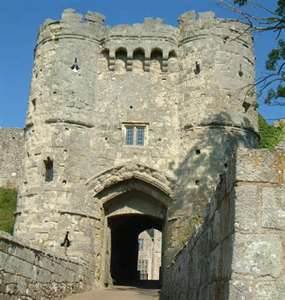
Carisbrooke Castle is an extensive fortress situated on a hill about a mile southwest of Newport, virtually in the center of the Isle of Wight. As a fortification, it has a very long history, because the Norman castle is raised on the site of a Roman fort and is surrounded in turn by Elizabethan defenses designed to withstand artillery.

The Elizabethan rampart surrounds the two baileys of the Norman castle in concentric fashion. This low, artillery-proof earthwork is encased in stone. There are arrowhead bastions at the corners and a fifth one on the west, commanding the entrance. Beyond the simple gateway through the rampart, one is confronted with the main gatehouse. It began as a thirteenth century gate tower but in 1336, at the start of the Hundred Years War, Edward III extended it outwards.

Round turrets flank the handsome façade and there is a row of machicolations above the entrance. The long gate passage, with three portcullis grooves, leads into a western bailey, which occupies the site of the Roman fort. Instead of utilizing the Roman wall, the Normans raised a massive rampart over it and piled up a lofty motte in one corner. Nevertheless, the Roman masonry still peeks out from the bank in several places.

Before long, a polygonal shell keep was placed on the motte and a new wall was built on top of the bailey rampart. The rampart is so powerful that the curtain only needs to be of modest height.

During the Elizabethan modifications, artillery bastions were added at the south corners of the curtains, but encased within both are square, open-backed towers. Clearly, they are early examples of mural towers and they are too small and too widely spaced to be effective as flankers. They support the written evidence that the curtain was built by Baldwin de Redvers.

Canterbury Castle

Canterbury Castle

Canterbury Castle

Considering the level of bombing sustained by the city in 1942, it is a miracle that so much of medieval Canterbury survives. Among the many attractions are the ruined castle keep and a large part of the city wall. Indeed, though incomplete, the wall of Canterbury ranks among the foremost in England.

The shape of the defenses was determined in the third century AD. The Roman wall enclosed an oval area nearly two miles in circumference, and the medieval wall follows exactly the same line. However, very little Roman masonry survives because the wall was rebuilt from the 1370s, when a French invasion seemed imminent.

More than half the circuit is preserved, extending from the site of the North Gate at the southwest end of the old city. The only gaps in this sector are those left by the demolition of the gatehouses. Eleven bastions survive, notable for their early “keyhole” gun ports. The four northernmost are square and date from about 1400, but the others are the traditional U-shaped type with open backs.

Canterbury Castle was probably founded soon after the Norman Conquest and certainly before the Domesday Book.. All that remains is the lower half of a large, oblong keep. The stepped splays behind the narrow window openings suggest an early date. The plinth and pilaster buttresses are typical Norman features. The entrance was at first-floor level in the northwest wall and excavations have uncovered a fore building.

The West gate is the only survivor of seven gatehouses in the wall. The fortress-like outer façade of the gatehouse, with machicolations overhanging the entrance and sturdy drum towers pierced by gun ports, contrasts with a more domestic townward front. Note the porticullis groove in the vaulted gate passage. The West Gate has survived because it housed the county gaol after the castle keep had become too derelict.

Caister Castle

Caister_Castle_4

Caister Castle

Caister Castle stands three miles north of Great Yarmouth, not at Caister-on-the-Sea, but a little inland at West Caister. This brick stronghold is a monument to Sir John Fastolf. Fastolf was a distinguished veteran of the Hundred Years War, a knight of relatively humble origin who played an important part in the Lancastrian conquest of northern France.

Falstolf built this castle in 1432-46 when he was enjoying a prosperous retirement. On his death in 1459, Caister passed to the Paston family, whose letters give a first-hand portrayal of life in fifteenth century Norfolk. Unfortunately for the Pastons, the Duke of Norfolk also laid claim to the castle and, when legal means had failed, he set about making good his claim by force. In 1469, he brought a considerable force to lay siege to the castle, which creditably held out for several weeks against the duke’s cannon before the inevitable surrender.

Veterans of the French wars built most fifteenth century castles and a number were in fashionable brick. They tended to be showplaces, combining lavish accommodations with a show of strength. Some had a secondary role in coastal defense and Caistor did repulse French raiders shortly after its completion.

Caister was one of the finest of its kind but rather too much was pulled down in the eighteenth century. The castle stands in a wide moat still full of water. It is one of those with an inner quadrangle and a subsidiary base court for retainers. This is less obvious now because the arm of the moat between the two courtyards has been filled in.

There is also part of a third courtyard behind, arrested only by a circular corner tower incorporated in a later house. The base court, of inferior brick, is now fragmentary and the main quadrangle had suffered so much destruction that only its north and west walls still stand.

Buckden Palace

Buckden Castle

Buckden Palace

Buckden Palace was a residence of the medieval bishops of Lincoln, allowing a midway break on the journey from London to their cathedral city. This Episcopal palace was entirely rebuilt in brick by Thomas Rotherham, who became bishop in 1472. After his transfer to York in 1480, it was completed by Bishop Russell.

The dominant feature is a tower modeled on the great brick tower at Tattershall Castle. Buckden’s tower house is oblong in plan with octagonal corner turrets rising above parapet level. However, it is less ambitious in scale and lacks the machicolated crown, which gives Tattershall such distinction.

The broad chimneybreast is a prominent and altogether domestic feature. Another obvious weakness is the tower’s proximity to the steeple of the parish church. They are separated only by the width of the former moat. This is typical of the castellated mansions of the later Middle Ages and shows that the builder was more interested in status than defense, though such towers must have had some value as refuge in the event of local danger.

The tower house could serve as a self-contained residence but the palace buildings were far more extensive. The inner courtyard contained a lavish suite of residential buildings and it is a pity they have all vanished. It is unusual to find a courtyard of this era, which is not quadrangular, so the layout was probably dictated by an older moated enclosure.

As well as the tower house, the inner courtyard preserves its diapered gate tower, with a range of ancillary buildings attached and the length of wall connecting the gatehouse to the tower house. This wall is pierced by arrow-slits but is too thin for a genuine curtain – the wall-walk is carried on a row of arches. Much of the precinct wall survives, as well as an outer gate giving access from the High Street.

Brancepeth Castle

Brancepeth_Castle

Brancepeth Castle

Brancepeth Caste, four miles southwest of Durham, was the original seat of the powerful Neville family. It is first mentioned during the Magna Carta war of 1216. In outline, the castle may date back to this period but nothing now standing is that old. The castle is similar architecturally to some of its late fourteenth century neighbors in the county and the rebuilding is attributed to Ralph Neville, first Earl of Westmoreland, after Raby was complete. Unfortunately his stronghold has been subjected to radical alterations.

From 1818 there was a heavy-handed restoration in neo-Norman style under the architect John Paterson, whose uninspired work has been justly criticized. The end result is a castle, which is a mishmash of original and sham features, best seen from a distance. Nevertheless, a considerable amount of medieval masonry has survived and the contrast between the old and the new is clearly apparent.

The castle is situated on a rise overlooking the Stockley Beck. It is a large, irregular enclosure surrounded by a strong curtain. The curtain looks complete, but some portions have been rebuilt. Paterson erected the present round-towered gatehouse on the site of the original. Most of the mural towers are authentic and have suffered comparatively little interference. These massive, oblong structures are unusual for the diagonal buttresses clasping their outer corners.

Proceeding clockwise from the gatehouse, we pass the Westmoreland and Constable towers, which have turrets rather than buttresses. Next comes the Russell Tower, a Paterson insertion, followed by three closely spaced towers containing vaulted chambers (including the so-called Barons’ Hall in Bulmer’s Tower). These three towers were attached to the main residential apartments, but the buildings, which now lean against the curtain on this side, are entirely of the nineteenth century. The curtain returns to the gatehouse via two small turrets.

Berry Pomeroy Castle

5123Berry_Pomeroy_Castle (1)

Berry Pomeroy Castle

Berry Pomeroy Castle occupies a spur of land falling steeply to the Gatcombe Valley, three miles northeast of Tornes. The ruins of a late medieval castle are juxtaposed with those of a great Tudor mansion. The Pomeroys settled here soon after the Norman Conquest but their castle dates only from the fifteenth century. It is probably the work of Henry Pomeroy who held the manor from 1446 to 1487. The new defenses were doubtless a response to the menace of French raids, the castle being just a few miles inland from Torbay.

Only one side remains of the castle defenses, comprising the gatehouse, the D-shaped Margaret’s Tower and the length of curtain between them. Enough survives to show that this was no regular quadrangle. The gatehouse has tall flanking towers with pointed fronts and a long machicolation between them. An arcade, the narrower part having served as the chapel, divides the chamber over the gate passage. A fine fresco here depicting the Adoration of the Magi shows Flemish influence, and its discovery led to the re-roofing of the gatehouse during the restoration of the 1980s. An earth rampart as reinforcement against artillery backs the curtain, and the walls are liberally supplied with gun ports.

The big residential block on the east side of the courtyard incorporates the Pomeroys’ hall and solar, but it was transformed in the large-scale rebuilding of the following century. In 1547, Sir Thomas Pomeroy sold the castle to Edward Seymour, Duke of Somerset and Lord Protector. As well as converting the eastern block, which survives as a well-preserved shell, he began an ambitious Renaissance mansion centered upon an immense new hall range on the far side of the courtyard, overlooking the valley. Unfortunately, it is too fragmentary to be readily appreciated. Somerset was executed in 1552 and his son completed the work on a reduced scale.


Berkhamsted Castle

Berkhamsted-Castle-plaque-2

Berkhamsted Castle

Robert, Count of Mortain and Earl of Cornwall probably founded Berkhansted Castle. It was certainly held by him at the time of the Domesday survey. As William I’s half-brother, Robert did well for himself out of the Norman Conquest, but his son made the mistake of supporting Robert of Normandy against Henry I. As a result, the Crown confiscated the castle. During the twelfth century it was leased to certain individuals, including Thomas Becket.

The castle is a classic example of a motte and bailey stronghold, even if roads and railway have gnawed at its edges. The motte is tall and conical, and a double ditch surrounds the bailey with a rampart in between. Until the 1950s, the inner ditch remained full of water.

In front of the outer ditch, on the north and east sides, following the circumference of the motte, rises a strong rampart. It is probably a concentric defense provided by Richard of Cornwall, though it has been suggested that the earth bastions that project from it could have been raised as platforms for treuchets during the Dauphin Louis’ siege.

The shell keep, which crowned the motte, has vanished but there are remains of the walls that descended to join the bailey curtain. Considerable lengths of this flint curtain survive, especially on the east side. At least some of the masonry dates from the time when Thomas Becket occupied the castle, though the money came from Henry II’s executor.

Three semi-circular towers flanked the curtain, and if they date from Becket’s tenure they are remarkably early. Little more than foundations are left of the towers now. The stump of a large oblong structure on the west curtain is probably the tower built by Richard of Cornwall in 1254. Foundations show that the north end of the bailey was walled off to form a separate enclosure, in effect a barbican in front of the motte.

Berkeley Castle

berkeley Castle

Berkeley Castle

Berkeley Castle rises on a low hill in sight of the Severn estuary. The castle is an appealing blend of Norman fortress and later medieval mansion, still remarkably unspoilt despite its continuous occupation by an aristocratic family, who might have been expected to rebuild or drastically modernize it in more recent centuries.

The motte and bailey layout may go back to William Fitz Osbern, but the oldest masonry here is the unusual keep. If it dates from Henry II’s contract with Robert Fitz Harding, about 1155, then the three semi-circular projecting bastions are remarkably early, though the plinth and pilaster buttresses are consistent with that date.

One of the bastions contains a well chamber and another formed the apse of a chapel. The keep belongs to the shell keep type but its high wall actually encases the motte instead of rising from the summit. A feature taken from the tower keeps of the period, is the fore building. This is an afterthought, enclosing a narrow staircase that ascends to the keep entrance.

A deep breach in the keep wall, facing the outer bailey, is the only damage wrought by the Roundheads following a brief siege in 1645. The oblong Thorpe Tower beside it dates from the fourteenth century. The keep is infamous for the murder of Edward II by his jailers, Sir John Maltravers and Sir Thomas Gurney, in 1327. According to tradition, the deed was done in the chamber above the forebuilding. Edward had been sent to Berkely for safety following his abdication, but dethroned monarchs seldom remain alive for long.

The keep stood between two baileys. Only a restored gatehouse survives from the outer bailey but the inner is still intact. It is reached via a fourteenth century gateway flanked on one side by the keep and on the other side by a narrow, oblong tower.

Beeston Castle

Beeston Castle

Beeston Castle

Ranulf de Blundeville, the most powerful of the palatine earls of Chester, began Beeston Castle in 1225. Prompted by the King’s growing growing mistrust, he built several strong castles to protect his territories. It is possible that Beeston was intended as an impressive new seat of administration away from the mercantile bustle of Chester. As an experienced soldier and crusader Ranulf clearly appreciated castles built in the new idiom – with round flanking towers and no keep – and the great rock of Beeston provided a wonderful situation for one.

An Iron Age fort occupied this site, two miles south of Tarporley, but Beeston is a product of the time when castle building was approaching its zenith. It occupies a huge sandstone hill rising dramatically out of the Cheshire plain. The castle does not have a keep as such but its compact inner bailey occupies the highest corner of the rock, so the Norman motte and bailey concept had not been entirely forsaken.

The outer bailey follows the contours of the hill and is large enough to gave accommodated a vast retinue. A nineteenth century gatehouse forms the entrance to the site, and some ascent is necessary before the real outer gatehouse is reached. More than half of the outer curtain has disappeared but the long section on the east side of the hill has seven towers, spaced closely together to provide effective flanking fire. These towers are the semi-circular, open-backed variety often found on town walls of this period.

A long ascent through the outer bailey takes us to the summit. A rock-cut ditch of exceptional width and depth, now spanned by a modern bridge, cuts off the inner bailey. A squat gatehouse, perhaps the earliest in England to be equipped with round-fronted flanking towers, guards the entrance. The site commands magnificent views.