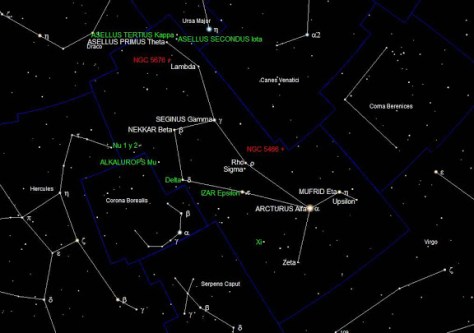
Pictures in the Sky
One of the earliest activities we engaged in when we first got into astronomy is the same one we like to show our children just as soon as their excitement about the night sky begins to surface. That is the fun of finding constellations. But finding constellations and using them to navigate the sky is a discipline that goes back virtually to the dawn of man. In fact, we have cave pictures to show that the more primitive of human societies could “see pictures” in the sky and ascribe to them significance.
Constellations also have been important in culture and navigation long before we had sophisticated systems of navigation. Early explorers, particularly by sea, relied exclusively on the night sky to help them find their way to their destination. In fact, when “Columbus sailed the ocean blue in 1492” and “discovered” America, he could not have done it without astronomy and the help of navigation of the cosmos, much of which is made possible because of the important constellations.
When learning to find the great constellations in the sky, we use the “find one, you found them all” system. That is because the easiest constellation to find will guide us to the rest of them. That constellation is The Big Dipper. Look to the northern sky on a clear night and widen your field of vision from just focusing on one star and it will pretty much jump out at you. In will look like a big kitchen pot or ladle, right side up in the fall, upside down in the spring.
When you have the big dipper under control, you can pretty easily find the North Star. This is the star that those ancient sailors depended on the most to find their way to land. Start with the far edge of the bowl of the Big Dipper, the side that is opposite the handle. There are two stars that make up that side of the bowl. So start at the bottom of the pot and mentally draw a line to the top star of the bowl. These two stars are “pointing” to the North Star. Just keep following that line, curving a bit with the sky and the bright star that you come to is the North Star. You can impress your friends or family if you know the scientific name for this star is Polaris.
The North Star can then take you to The Little Dipper. The key here is that Polaris is the tip of the handle of The Little Dipper and the bowl hangs down from the handle like it was hanging up in the kitchen. Be patient with this one as the stars that make up The Little Dipper are dimmer than The Big Dipper. But it pretty cool once you find it.
These are the obvious starting places but from The Little Dipper you can find the constellation known as “The Swan” or Cygnus. Just use the same system you used to find The North Star but continue drawing that line that started in those pointer stars in the bowl of The Big Dipper. Go about half as far as you went to find Polaris and you are there. You will see a trapezoid of stars about as big as The Big Dipper. This trapezoid forms the tail of The Swan.
That line that we are drawing from the pointer stars is our roadmap to another well known constellation which is Cassiopeia. If you use that line and imagine you are directly under the two pointer stars, you will se a big “W” just off to the left of the line. This is the constellation Cassiopeia, the wife of the king of Egypt, Cepheus, in Greek mythology. There are so many more wonderful constellations to find and a good star map can continue your quest.
Like Cassiopeia, all of the constellations have wonderful stories and myths related to Greek culture. It is just as fun to find the star clusters themselves as it is to enjoy the rich culture related to that constellation. For all of the signs of the zodiac, for example, there is a related constellation in the sky. So whether you are serious about astrology or not, its fun to find the constellation that relates to your “sign” (or that of your children) and be able to see how the ancients related to these pictures in the sky.








 Nerdome
You must be logged in to post a comment.