8 Ways To Increase the Endorphins In Your Brain.

This gallery contains 1 photo.

Endorphins…trigger a positive feeling in the body similar to morphine. For example, the feeling that follows a run or workout is often described as “euphoric.” That feeling…can be accompanied by a positive and energizing outlook on life. – WebMD Endorphins are classified as an “endogenous opioid neuropeptide.” In other words, these brain chemicals boost our overall mood […]

Que Pasa cuando Morimos ?

This gallery contains 3 photos.

Teoría Cuántica demuestra que la Conciencia se mueve a otro Universo después de la Muerte Verdad o Mentira ? Danos tu Opinión . Lanza es un experto en medicina regenerativa y director científico de Advanced Cell Technology Company. Antes de que él fuera conocido por su extensa investigación que se ocupa de las células madre, […]

Anonymous Message To The Indigo Children Of The World.

Anonymous releases message, this time ONLY to the indigo children!

There is a shift in consciousness taking place.

As time goes on, this only becomes more obvious and more people start to realize they can be who they are. Yes, there still might be trailblazers needing to lead the way, but things are only leading further and further into the direction of bringing spirit back into balance with our mind and physical body in this experience we call life.

Embrace it!


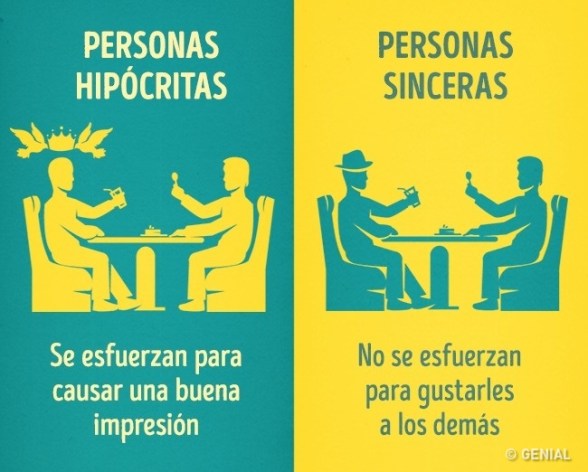
8 Señales que te ayudarán a distinguir a una persona sincera de una hipócrita.

Diferenciar a una persona honesta de otra que finge no es tan difícil: hay señales por las que resulta fácil determinar quién es quién, sólo hay que estar atento.

Para que te sea más fácil recordarlas, Genial.guru resumió de forma esquemática las diferencias entre una persona que dice la verdad y otra que es hipócrita.


Source:https://genial.guru/inspiracion-psicologia/8-senales-que-te-ayudaran-a-distinguir-a-una-persona-sincera-de-una-hipocrita-329160/

Five of the Worst Ways to be an Empath.

“The most beautiful people we have known are those who have known defeat, known suffering, known struggle, known loss, and have found their way out of the depths. These persons have an appreciation, a sensitivity, and an understanding of life that fills them with compassion, gentleness, and a deep loving concern. Beautiful people do not just happen.” ~ Elisabeth Kübler-Ross

Having discovered you are to some degree, an empath, and that all those years of thorn tingling feelings and draining encounters really meant something. Having discovered the reason why you love people yet avoid them at all costs as they make your head spin and have a difficult time building balanced relationships that don’t leave you feeling resentful if not bitter and angry. You’re probably ready to start confronting those confusing and infuriating emotions by taking action. But first, let’s locate exactly what not to do.

Resistance

Your chosen path is as an empath, and it will happen whether you like it or not. Having been unaware for so long, you may have been dragged through the experience backwards and have accumulated a fair amount of bitterness if not despair about why this keeps happening to you. Every time you forgive others for their atrocious behaviour, for downright taking advantage and walking all over you, you find that you fall straight back into the trap and spend days and weeks, if not years resenting them (and are secretly angry at yourself for allowing it to happen).

empaths-582x437

Victimization

In social situations you soak up everyone else’s shit and willingly take the flak for every little invisible tension or thing that goes wrong, letting others gang up on you and dump all their projections onto you. You probably do this on a subconscious level in order that everyone is able to enjoy a certain level of comfort or distraction from their own downfalls, that’s detrimental to yourself of course. You willingly become the victim; letting the hailstorm of emotions swirling around you hit you full force and worst of all… you believe you deserve it. You become the people pleaser, the scapegoat and the fool.

Karmic Patterns

To be honest, the reason that you have become an empath is probably because you have chosen, in this life or beyond, that you would have an intense and probably unpleasant… if not entirely terrifying experience. These might include the experience of death firsthand (see the Orphan Archetype), a public downfall (killed in a riot, accused of witchcraft), a grand scale or group suffering (war, the atomic bombing of Hiroshima, the sinking of the Titanic) or many other thousands of possibilities that allowed you to experience the height of human suffering. This might have happened in this lifetime and you’re aware of it, but you must understand that your soul chose to experience it in order to get where you are now. Feeling like everyone’s enemy is often also the path of the famous as they are more vulnerable and open to negative energy and harmful thoughts against them as well as criticism, doubt and vampirism.

near-death-experience

Exhaustion

Soaking up others emotions on a daily basis is exhausting in itself, but if you are the sort of empath who is a people pleaser, you will also let everyone gang up on you. You mislead others into thinking you’re a child or emotionally weak in order to relieve those awkward situations and let them dump it all on you. Your low self worth and low self respect lead to this (having decided that you deserve it – victimization), and that cycle of victimization only leads to more exhaustion. You have become concave, withdrawn, a vacuum of energy and are unable to draw any boundaries. The fact that you chose this path, which means you are stronger than you could ever imagine, makes no difference. You are completely cut off from your higher self and the divine and have no energy to look at basic daily functions such as looking after yourself and making a living let alone shining your bright light and lifting up others around you (which you have an inkling you should be doing.) The realization that you feel far from your true path only adds to the exhaustion.

Giving Up

Being totally overwhelmed by the lesson you have chosen, you’ve caved in. You have let people walk all over you for so long, you’ve shut down. Your armor is so thick most people are put off before you even give them a chance to get to know you. You have become so numb and angry that you’ve completely shut the world out. As sad as it is, the hole isn’t as deep as you think. People respond to your energy, and as sensitive and sponge-like as you may feel, you have the ability to easily transcend the complex swirls of emotion. Having worked on your boundaries, you are able to lift your head out of the pool and see the bigger picture. By realizing that you are in complete control and always have been, you are able to stop being the victim and direct your energy from your centre rather than the outside to become the shining light you truly are and do the work you set out to do.


Source: https://fractalenlightenment.com/34245/life/five-of-the-worst-ways-to-be-an-empath | FractalEnlightenment.com

These 7 Buddhist monk habits are hard to adopt but they’ll change your life forever.

What’s the secret to feeling calm and focused?

It’s not an easy question to answer.

So, why do Buddhist monks appear peaceful and present all the time?

How do they do it? Do they know some hidden secret that you don’t?

Actually, yes they do!

For thousands of years, Buddhist philosophy has focused solely on how to reduce human suffering and keep the mind focused on the present moment.

And today, we’re going to go through Buddhism’s most important principles and habits that we can all adopt in our daily lives.

While they may appear difficult at first, if you keep at it, they’ll benefit you for a lifetime.

Habit 1 – Outer decluttering

Did you know that the Buddha was born a prince? Yep, he could have spent his life in a big, beautiful palace where everything is done for him.

But he didn’t.

He abandoned everything when he realized the frustrating nature of materialism.

2300 years later, Buddhist monks do the same. They keep material possessions to a minimum and only hold what they need to live their life. Usually this will all fit in a small backpack.

They completely declutter their life.

Habit 2 – Inner decluttering: taking care of others

In many Buddhist circles, monks learn to do things not for themselves, but for the whole world.

When they meditate, it’s for the sake of everyone. They attempt to attain enlightenment to reach their full potential and help those in need.

When you can develop this kind of selfless attitude, you focus less on your personal problems. You get less emotional about small things and your mind becomes more calm.

This is what’s called inner decluttering: making room for others and dumping selfish habits.

Habit 3 – Meditating A LOT

One of the main reasons you become a monk is to have more time to meditate. Most monks wake up early and meditate for 1 to 3 hours and do the same at night. This kind of practice changes the brain. If you’ve read any articles on the benefits of meditation, then you know what I mean.

You don’t have to adopt this kind of rigorous schedule, but what if you started the day with 30 minutes of meditation?

Habit 4 – Following the wise

In western society, we have an unhealthy relationship with old age. But for Buddhist monks, they see elder people as having wisdom. They seek elder spiritual guides that can help them on their path.

If you look around, there are always insightful people to learn from. Older people have more experience which means they can offer countless life lessons.

Habit 5 – Listen mindfully and without judgment

Our brains naturally judges others. But according to Buddhists, the point of communication is to help others and ourselves suffer less.

Criticizing and judging obviously doesn’t help.

What’s wonderful about mindfulness is that it’s judgment-free. The main goal of mindful communication is to take in everything that someone is saying without evaluating it.

So many of us pre-plan our answers while we’re listening but the main goal here is to simply take in all that they are saying.

It leads to more mutual respect, understanding and chances for progress in the conversation.

Habit 6 – Change is the only law of the universe

According to Buddhist master Sazuki, a crucial principle we all need to learn is to accept change:

“Without accepting the fact that everything changes, we cannot find perfect composure. But unfortunately, although it is true, it is difficult for us to accept it. Because we cannot accept the truth of transiency, we suffer.”

Everything changes, it’s the fundamental law of the universe. Yet, we find it hard to accept it. We identify strongly with our fixed appearance, with our body and our personality. And when it changes, we suffer.

However, Sazuki says we can overcome this by recognizing  that the contents of our minds are in perpetual flux. Everything about consciousness comes and goes. Realizing this in the heat of the moment can diffuse fear, anxiety, anger, grasping, despair. For example, it’s hard to stay angry when you see anger for what it is. This is why Zen teach that the moment is all that exists.

Sazuki says: “Whatever you do, it should be an expression of the same deep activity. We should appreciate what we are doing. There is no preparation for something else”

Habit 7 – Living the moment

As humans it can be tough to simply embrace the present moment. We tend to think about past events or worry about what the future holds. Our mind can naturally drift.

But mindfulness encourages us to refocus. Practising mindfulness enables us to get better at redirecting our thoughts back to what we’re actually engaged in.

Without judging ourselves for getting lost in our thoughts, we simply acknowledge that we lost our attention and direct our focus to our senses or any task we’re engaged in.

It takes discipline but it’s what we need to do if we want be present for the miracles of life.

Source: http://thepowerofideas.ideapod.com/7-buddhist-monk-habits-hard-adopt-theyll-change-life-forever/
13 FACTS ABOUT TIME THAT WILL HURT YOUR BRAIN.

1. Passage of time is faster for your face than for your feet (supposing you’re standing up). Einstein’s theory of relativity states that the nearer you are to the center of the Earth, the slower time passes – and this has been already measured. For an instance, at the top of Mount Everest, a year would be about 15 microseconds shorter than at sea level.


2. A second isn’t what just you consider it is. Technically, it’s not defined as 1/60th of a minute, but as “the duration of 9,192,631,770 periods of the radiation consistent to the transition between the two hyperfine levels of the ground state of the caesium 133 atom”.
 3. When the dinosaurs ruled the Earth, there were nearly 370 days in a year. The Earth’s rotation is getting slower because the moon’s gravity is acting as a drag, so days are getting lengthier, by about 1.7 milliseconds per century.

4. This one is good. On Mercury, a day is two years long.

5. The least standard scientific amount of time is the “Planck time”. It only takes you about five hundred and fifty thousand trillion trillion trillion Planck times to blink one time, rapidly.

6. There’s nothing as “now” according to physics. Space and time are like fluid, affected by gravity and even your speed. Albert Einstein put it like this: “For us physicists, the distinction between past, present and future is only an illusion, however persistent.”

7. Since light takes time to reach us, whatever we see is in the past. The sun you can see in the sky is 8 minutes and 20 seconds old. The light from our nearby star, Proxima Centauri, is about 4 years old.

8. New experiences certainly do appear to be longer in the memory than familiar ones. It’s known as the “oddball effect”, and it appears to be why time feels like it’s going faster as you get older – since more stuff is familiar to you.

 9. The most precise clock ever constructed is the strontium clock, which is precise to within a second over 15 billion years.


10. The oldest acknowledged thing in the universe is a galaxy called z8_GND_5296. It’s 13.1 billion years old – only 700 million years younger than the cosmos itself.

11. The cause behind why clocks show the same time across entire countries is that it makes train timetables easier to run. Till the 19th century, towns set their clocks by the local time or noon, so clocks in Bristol would be 11 minutes behind London. That destined people kept missing their trains, so railway firms began using standard, London-based UK time, initiating with the Great Western Railway in 1840.

12. Time might be crunching to a pause. Distant galaxies seem to be moving faster than close ones, signifying that the cosmos is accelerating as it expands. The normal theory to clarify that is a mysterious force in the cosmos known as “dark energy”. But a Spanish physicist has suggested an alternative prospect that the further-away, older galaxies only appear to be moving faster because in the past, time was faster. If he’s correct, in a few billion years, “everything will be frozen, like a photo of one instant, endlessly”.

13. Next week, your watch will be one second behind. The fact that the Earth’s spin is decelerating, and consequently the days are getting longer, means that our 24-hour day is very to some extent off. Every so frequently, the International Earth Rotation Service, the bodywhich standardizes astronomical time, has to add a second – called a “leap second” – to the clock to retain things consistent. The recent leap second was on June 30, 2015.


Source: http://www.sci-techuniverse.com/2016/01/13-facts-about-time-that-will-hurt-your.html

The 1 Habit All Intelligent People Practice.

getty_519434169_20001330200092800_201986

Surrounded by voyeuristic screens and engulfed by never-ending stimulation, our brains are undergoing transformation. Modern life offers many advantages, not the least of which involves the technology that provides us with opportunities that our ancestors couldn’t imagine. Unfortunately, the need to feel constantly connected to the digital realm negatively impacts several areas of our lives.

Unlike the older generations that had more peace and quiet, we are always plugged in, and that makes our habits more important than ever. It’s much easier to get lost in social comparisons and overindulge in eye candy on Instagram than it is to force yourself to do something uncomfortable that will ultimately add value to your life.

As a life coach and licensed therapist, I help my clients follow their intuition. I give them permission to do the behaviors that will bring them the greatest amount of fulfillment and personal success, which often involve spending less time on social media and more time passionately pursuing other interests. Studying the behaviors of leaders in diverse fields, while earning my doctorate in clinical psychology, has taught me that all pioneers have one thing in common.

All great minds read.

Yes, every single intelligent person who has a lasting impact reads. It doesn’t matter if they’re in script-writing or neuroscience; the people who change industry standards are the ones who read books.

Not only do the all-time greats across industries read–they do so on a consistent basis.

Instead of spending time getting caught up in Facebook drama or taking selfies on Snapchat, the real difference-makers have their noses in books. They are broadening their intellectual horizons, gaining energy, and allowing their minds down time from the overwhelming stimulation of society. And science supports the value of flipping pages.

Studies show that reading not only increases your verbal intelligence, but can also improve scores on your overall intelligence and boost your memory. Other research shows that reading can help you relax by reducing stress as much as 68 percent, which is one reason that the Mayo Clinic, in a different study, concludes that reading (a physical book, not a screen) helps people fall asleep each night. However, don’t think that reading short articles online is enough.

The most brilliant individuals–the people who truly make a lasting impact on the world–don’t just read regularly, they also read for depth.

For someone passionate about the field of psychology, for example, reading popular self-help books isn’t enough–he or she needs to read Freud. Dedicated writers can’t read just the current best sellers–they need to study the classics to refine their craft and expose themselves to literary possibilities they haven’t seen before.

People who change entire industries challenge themselves when they read. They know that struggling to parse more difficult content, although laborious, is the only way to raise their ceiling. Most people spend their time reading candy articles and popular books. What they fail to realize is that doing so may keep their imagination active, but it won’t take them to the next level of personal and professional excellence.

The only way that you can change the world is by transforming the way you think about reality. The tried-and-true way to gain access to other unique perspectives is to read books on a consistent basis that force you to grow–emotionally and intellectually–in ways you never thought were possible.

So, put down your tablet, phone, and close your computer. Tell Netflix and HBO to wait–I promise that the flashy screens and endless entertainment will be there tomorrow. Give yourself time and space to get lost in a book, and reconnect to your values.

Read on a consistent basis, and read for depth. It’ll make you a more intelligent person and a better professional.

Source:https://www.inc.com/matthew-jones/all-great-minds-have-this-1-habit-in-common.html?cid=sf01002&sr_share=facebook